


This 1,146-kilometer commemorative roadway known as the Liberty Road (La voie de la Liberté), marks the route of the Allied forces from the D-Day landings of Normandy, France to Bastogne, Belgium. Our plan was to ride the entire route and learn more about the history of WWII. The GPX route can be download via RouteYou.

Day 1 – 9 Apr
Today we explored Utah Beach, Utah Beach Landing Museum, Sainte-Mère-Église, Dead Man’s Corner, The D-Day Experience, and the Eglise Notre Dame des Champs in Avranches.


A monument to Richard Davis “Dick” Winters. Read more about this Easy Company commender of the 101st Airborne Division: https://en.m.wikipedia.org/wiki/Richard_Winters

The KM 00 stone marker (borne) located at the start of D-Day at Utah Beach, Normandy, France.

The beach where 21,000 US, UK, and Dutch Infantry landed here on June 6th, 1944.

Well-wishers leave flowers to remember the fallen. The 4th Infantry had relatively few casualties at 197. The airborne divisions suffered a staggering 2,500 – nearly 18 percent of the airborne divisions involved!

A horse pulls a Sulky cart and rider through the surf of the English Channel.

Looking back at the beach entrance and museum from Utah Beach.


Monument de l’US NAVY – A monument dedicated to the US Navy Sailors of Operation Neptune. 6,939 vessels were involved: 1,213 combat ships, 4,126 landing ships and craft, 736 auxiliary, and 864 merchant vessels.

A small section of barbed-wire still exists as a reminder of the German fortifications which were built here.

A M4A1(76)W HVSS Sherman Tank marks the entrance to the museum.
Utah Beach Landing Museum
A museum dedicated to the individuals who served during the D-Day assault and those who keep the memories of the world’s largest naval, air, and land operation alive for future generations.

The monument of the 4th Infantry Division marks the museum entrance.

Utah Beach was just one of five planned amphibious landings. Omaha Beach, to the east, suffered the most American losses.

The flag of the National Socialist League of the Reich.

June 6, 1944 – Allied landing in Normany: D-Day

Dollar bills recovered from the beaches. All were dated before 1944.

French aviators, although small in numbers, also participated in Operation Overlord. Their presence symbolizes the rebirth for France. When we visited the UK last year we saw plaques dedicated to many of these French aviators.

A Martin B-26 Marauder named “Dinah Might” painted to represent the 386th Bomb Group – 9th USAAF.

Meet some men who made the D-Day landings such a success. This is Guy Whidden, he served in the 101st Airborne Division.

Here is Vernon Moon Miller. He served on the USS Cincinnati as a Boatswain’s Mate Third Class.

Meet George Shenkle, who was a part of the 82nd Airborne Division.

Charles de Vallavieille who dedicated his life to preserving the memory of Utah Beach through the Utah Beach Museum.

Cécile et Yves Osmont, who had dedication much of his like to model building and preserving the memory of the naval units involved in the D-Day landings.

James Flanagan and his comrades proudly display a trophy taken after the attack on Marmion positions at Ravenoville.

The Willys MB were successful, off-road capable, light utility vehicles. Willys built over 350,000 of these from 1940-1945.

Somehow, I doubt soldiers heeded this limit 😆.

This 48-star US flag was raises over the first German bunker captured on June 6th. It remained in place there until November before it was claimed by a local and then later donated to the museum.

The start of our ride! In 4-5 days we plan on reaching the 1,146 km borne marker at Bastogne.
Sainte-Mère-Église

A short ride from Utah Beach is the the first town liberated by the allies: Sainte-Mère-Église.

The Sainte-Mère-Église church is famous for a paratrooper named John Marvin Steele, that got his parachute hung up on the church tower. John hung there for two hours pretending to be dead. The Germans later took him prisoner but he escaped and rejoined his division.

Beautiful stained glass windows dedicated to the valiant paratroopers of Normandy.

Peace…

…and paratroopers is now the theme of the church.

Those who enter are asked to think and pray for peace.

Across from the church we found a cafe that served the most interesting grilled ham and cheese sandwich I’ve ever tasted. It combined cheese slices and cheese sauce which was different but delicious.
Dead Man’s Corner

A few km south of Sainte-Mère-Église is Dead Man’s Corner. It was named for a battle in which an American tank was disabled by a German rocket. The American tank commander hung dead from the turret for a few days before follow-up crews could clean-up and identify the dead bodies.


The home is now a museum full of thousands of WWII memories.

German for ‘sick collecting point’.


French pamphlets written in a English to welcome the Allied invasion.

We also learned about the Jake McNiece and the Filthy Thirteen of the 506th Parachute Infantry Regiment. The demolition section cut their hair and applied war paint to honor the “mohawks” and McNiece’s Native American heritage.

The 101st Airborne Division “Screaming Eagles”!

The ‘D-Day Experience’ takes you on an interactive journey as you prepare to board a C-47 named “Stoy Hora” in preparation for the D-Day aerial assaults.

The Dakota C-47 Stoy Hora has an interesting story and does a great job of making the paratrooper experiences more personal.

A museum features items from the crew, including this jacket with a lucky rabbits foot worn by Pvt. Edward Joint.

Papers reported the allied invasion shortly after it’s success.
Liberty Road
Our route continued to the southwest through the following towns:
- Montebourg liberated on 19 June 1944
- Cherbourg liberated on 26 June
- Carentan liberated on 12 June
- Pont-Hébert liberated on 17 July
- Saint-Lô liberated on 16 July
- Marigny liberated on 25 July
- Coutances liberated on 28 July
- Lengronne liberated on 29 July
- Avranches liberated on 30 July
Eglise Notre Dame des Champs

The unique colored door of the Eglise Notre Dame des Champs in Avranches.

The Eglise Notre Dame des Champs was bright in comparison to many cathedrals.

For some reason I think of Monty Python’s Holy Hand Grenade! 😆


A statue of the Archangel Michael slaying Satan. This will be another popular art form tomorrow as we learn more about Mont-Saint-Michel.

Just before sunset we reached the impressive island fortress of Mont-Saint-Michel. My zoom camera did a decent job of getting closer to the island but we wanted to get a closer shot…

So we launches the drone. I had to fly it nearly 1.2 miles to get close enough to get this…

…stunning shot! The timing and lighting was near perfect. Ok, now I needed to get the drone back before the battery life expired.
Tomorrow we’ll visit this island in person and take a tour of the incredible abbey at the very top of this UNESCO World Heritage Site.
More on Page 2…
Day 2 – 10 Apr
Mont-Saint-Michel
You can ride a bus, take a horse drawn carriage, or walk from the parking lot to the island. We ended up riding the first bus of the morning so we could enjoy the site without the crowds of tourists.
Like a medieval, fairy-tale fantasy, sprouting from the sea, Mont-Saint-Michel is one of the most recognizable icons of France and a UNESCO World Heritage Site.

A cloudy and cold morning. We arrived at 0800 – well before the crowds of tourists.

The shops with their colorful signs were all still closed. There are not many people who live here – population is about 50 folks.

Looking up at the Abbey from the walled streets.

Birds fly and roost on chimneys and rooftops.

A model of the Abbey with its iconic statue of Archangel Michael at the top.
The Abbey opened at 0930. We purchased the audio guide and made our way from room to room learning about this amazing structure which began it construction in the 10th century.

There were no decorations except for some simple tables, chairs,…

…and some sculptures.


The cloister was especially impressive with great views of the central and surrounding gardens.

The dining hall was a massive room.

Intricate details of carved stone reliefs between pillars.


Simple stained glass windows.


Looking up at the chancel of the abbey church. This portion fell down in 1421 was replaced by the Gothic Flamboyant chancel.


The pillars and buttresses support the weight of the stone ceiling.

The treadwheel crane which served as a windlass during the time the Abbey was used as a prison. The crane was powered by prisoners who would walk inside the wheel to rotate it…

…bringing supplies from way down there!

This is the exposed Rock of Mont Tombe. Touching the stone is considered to confer healing properties.

We left the Abbey and continued down to the shops which were now full of tourists, except for this narrow walkway we explored earlier that morning.


We bought this small Archangel Michael as a memory of our trip to the beautiful and impressive Mont-Saint-Michel.
We took a short bus ride from Mont-Saint-Michel to a small shopping area where we could grab some breakfast as the local bakery.

Now this cow is destined for traveling the world!

This was the most delicious breakfast pastry I have tasted in a long while!! Heavenly! Délice Croustillant aux Fraises (Crispy Delicacy with Strawberries)

A final view of Mont-Saint-Michel before we continue along the route.
Back on the Road to Liberty

Along the way we would occasionally stop to take pictures: In Ranazé we noticed a modern church building with unique murals painted on the entrance wall.


Another beautiful mural painted on a large brick building.


Love the detail of the people and the birds.

A simple brick home with unique colored window shutters reached out to my camera to take its picture.


Nearby was this brightly painted car!
Today we rode through:
- Saint-Servan liberated on 17 August 1944
- Saint-Malo liberated on 16 August 1944
- Rennes liberated on 4 August 1944
- Angers liberated on 10 August 1944…
…and ended the day at Camp de Port Caroline near Angers, France.
Tomorrow we will explore Circuit des 24 Heures du Mans and the Cathédrale Notre-Dame de Chartres.
Onward to Day 3…
Day 3 – 11 Apr
Today we explored Circuit des 24 Heures du Mans and the Cathédrale Notre-Dame de Chartres (Chartres Cathedral). We rode through the following cities and towns along the Liberty Road:
- Le Mans liberated on 8 August 1944
- Chartres liberated on 18 August 1944
Circuit des 24 Heures du Mans

A large sign greats visitors to the race course which is currently 13.6 kilometers (8.5 mi) long, making it one of the longest circuits in the world.

The Musée des 24 Heures du Mans is a museum containing nearly 100 years of La Mans racing memorabilia to include race cars, models, clothing, and artwork.

When I hear the word “hybrid” I think of fuel efficiency cars like the Toyota Prius. However; this 2016 Porsche 919 Hybrid should change your mind. Its 4-cylinder, 2.0 liter, twin-turbocharged engine and lithium battery rocketed this car to numerous victories. Top speed is an impressive 345 km/h (214 mph)!!

I love how it went from the race course to the museum; including all the scratches and gravel from the race track.

Artwork, in all varieties decorated the museum walls and displays.

Although the Le Mans has primarily been a European event, the “land of the rising sun” made history with this rotary engine powered 1991 Mazda 787 B Maquette taking the podium!

Ferrari best successes in the late 50s and early 60s with seven wins.

My favorite racing era is the late 40s and 50s…

…because I think the cars of that generation are some of the most beautifully designed with their timeless aerodynamic curves and lightweight simplicity.

These French D.B. race-cars look great in blue!

Pure simplicity.

The 30s was also an exciting time for sports-car endurance racing.

A British 1935 Singer Nine (green) and a 1931 Aston Martin International (black)

Check out all the safety equipment of the 30s!


My favorite Le Mans car is the Porsche 550 of the 50s. This car is what I feel is the ultimate sports car: small, aerodynamic, and simple. I also think it’s pretty sexy! Original 550s sell for more than six-million dollars!! Perhaps, someday, I may have a drivable replica.

Le Mans also has a history of motorcycle racing. Check out these vintage helmets and goggles.

1933 BMW R11 with its classic 2-cylinder opposed piston engine.

After the museum, we walked to the track to watch student enjoying driving Audi performance cars on the track.


Placing my hand in the same place British driver Allen McNish placed his after winning the 2013 Le Mans.

A unique experience and and enjoyable two hours learning about a race steeped in history.
We continued along enjoying the French countryside and relaxing two-lane roads of the Liberty Road.
Chartres Cathedral

The French commune of Chartres is beautiful with its world-famous cathedral.


A mural of a man wearing a hat is painted and shaded using a technique of small circular spray-painted dots.

The main door to the impressive Chartres Cathedral. This is a UNESCO World Heritage Site because it preserves the best of French Gothic architecture.

The cathedral is famous for its unique labyrinth which is made from stone tiles. Unfortunately, there was chairs covering much of the labyrinth so we were not able to walk along the paths. I understand that each Friday from 10 am to 5 pm from Lenten season to the “day of the saints,” the chairs are removed.


The impressive north transept rose window built in 1235.

All the large stained glass windows create a relatively dark but richly coloured interior. I especially like the violet blue surrounding the choir.

The experience of being in the town center when the cathedral bells began to sound was comforting and created a memory that will forever remind me of Europe.

We found a camp site right in town with friendly service and a large field to park our mules and set up the tent.
Tomorrow we’ll continue along the Liberty Road heading east towards Reims.
Continue to Day 4…
Day 4 – 12 Apr
Day 4 of the Liberty Road. We rode through the following cities and towns along the Liberty Road:
- Étampes liberated on 22 August 1944
- Fontainebleau liberated on 23 August 1944
- Épernay liberated on 28 August 1944
- Reims liberated on 30 August 1944
- Valmy liberated on 30 August 1944
Les Fresques de Bel Air

Welcome to Bel Air! No, this isn’t some Richy-Rich residential neighborhood near Beverly Hills, California. This place is much more interesting.

These post-war government housing buildings have been transformed…

In 2008, city-endorsed artists transformed these apartment buildings into something unique…

…and exciting!


Each of the separate buildings have a theme.


The Labyrinth of the Cathedral Notre-Dame of Chartres.


The colors of the building complimented well with the surrounding, well-kept, landscape.

The stain-glass windows of a church were represented on the sunrise side of this building:

Hanging put with the local baker! For anyone who loves murals and street art, the Fresques de Bel Air is a excellent stop.
In the afternoon we arrived at the Château de Fontainebleau in Fontainebleau, France.
Château de Fontainebleau


This palatial estate stated as a royal hunting lodge in the Roman times.

Statues reminiscent of that era provide a reminder of its past.

There was a large amount of construction going on. I imagine it must be a never-ending process when you own a French castle.


Inside the garden area, named The Garden of Diana, is a unique fountain…

…of Diana, the Roman goddess of the hunt. This is a replica since the original was moved to the Louvre Museum in Paris in the 1600s. However, it’s not necessarily the Roman goddess that makes this fountain unique – it’s the…

…the peeing hunting dogs that surround the statue! Their somber faces would indicate they aren’t too pleased to be permanently mid-pee.

Although, we didn’t have time to walk through the rest of the palace, we did enjoy walking around the buildings and park areas…

…where swans swam along the green-algae filled pond.

It was a nice sunny day and the sounds of kids laughing and playing could be heard nearby. The Château de Fontainebleau was definitely worth the stop.

Liberty Road

The ride continued on with these roadside borns marking the way, nearly every kilometer.

We took a break to get some pictures of us and the mules passing by the borns.

I was surprised to see a windmill that would be perfect sitting in the plains of the western United States.

Passing by small French town with majestic central churches.
What is this? A French school, named after an American President, with a unique WW2 history.
Lycee Roosevelt

The flags of the UK, USA, France, and the Soviet Union fly to remind everyone of the historic event that occurred here in the early morning of May 7th…
…where German delegation, led by Generaloberst Alfred Jodl, the representative of Admiral Karl Donitz (successor to Adolf Hitler), signed the document on behalf of the German High Command, effectively signaling his country’s unconditional surrender and ending the war in Europe.

The letters above the school entrance read “It is here that on 7 May 1945, was signed the act that ended the Second World War in Europe.”
A small museum occupies a room explaining the historic event that occurred here in at 2:41 AM, May 7th, 1945.

Celebrating the end of WWII was a fitting way to end our 4th day of the Liberty Road.
More tomorrow on Day 5…
Day 5 – 13 Apr
Day 5 and our final day of the Liberty Road. We rode through the following cities and towns along the Liberty Road:
- Gravelotte liberated on 13 December 1944
- Nancy liberated on 15 September
- Rozérieulles liberated on 20 November
- Metz liberated on 19 November
- Thionville liberated on 12 September
- Luxembourg City liberated on 10 September
- Arlon liberated on 10 September
- Bastogne liberated on 10 September

That is frost on my mule!! It was -2°C last night. Thankfully we stayed nice and warm in our sleeping bags…

…but getting up and packing for the day was not enjoyable.

Along the route I noticed a French cemetery.

All the headstones were French soldiers from WWI.

Morning sun shining through the French flag 🇫🇷

A beautiful, but cold, morning in the French countryside.

More needless deaths of 1916. Behind these names where countless tears shed by mothers of lost soldiers.

We stopped near an France army base and took this picture next to this tank.

A unique windmill in the countryside and rolling hills of France.

For lunch we stopped at this restaurant. We were the first customers of the day, but within 30 minutes, all the tables were filled with people enjoying the Saturday afternoon with family and friends.

Although nobody spoke English, we were able to successfully order a delicious ham with potatoes. The ham was cooked in this large oven.

Plenty of food and drink for the two us cost €16.20

As we traveled through one town we came across this vending machine for bread! A couple, driving the red car, thought this was a great idea as well.

A Pegasus farm!! Now that is something I would like to see!
Église Saint Maximin Church, Metz, France
This is not one of those grand cathedrals that rises from a central courtyard with spires that reach towards heaven; it is a small church sandwiched between dated apartment buildings. It’s not the buildings architecture that makes it stand out; it’s the unique stained-glass windows.
The windows were the final project of avant-garde artist Jean Maurice Eugène Clément Cocteau. He was a French poet, writer, designer, playwright, filmmaker, and stained-glass artist.

His unique designs were abstract and cubism with blue hues. Much of his work was compared to Chagall and Picasso.

The church also doubled as an art gallery which featured these textured cloth sculptures that were lit from the center.

The windows drew controversy, since they were significantly more experimental than the stained glass in most Catholic churches.

Beautiful abstract artwork decorated the church walls.


More of the sculpted cloth that creating sharp lines and abstract textures for my camera’s eye.


I was interested in this statue of Jesus as a child being held by his father, Joseph. This is unique because I hardly see Joseph being represented; it’s most always Christ’s mother, Mary.

Église Saint Maximin was a nice diversion and a quite place to reflect on the final project of Jean Cocteau.
Liberty Road, Luxembourg & Belgium

Shortly after noon, we arrived to our fifth country of the trip: Germany 🇩🇪 Netherlands 🇳🇱 Belgium 🇧🇪 France 🇫🇷 and Luxembourg 🇱🇺!!

Luxembourg has the cheapest gas we’ve seen in all of our European travels. Still expensive compared to the US: Europes 95 octane is about the same as 87 octane in the USA. 1.256 €/liter = 5.35 $/gal

As we left Luxembourg City we saw this building covered in murals.

I like the use of bright orange and violet colors of this mural.

Unique complimentary orange and blue colors on one side of the building.

Near the end of the day we came across the Monument National des Chasseurs Ardennais – A memorial to all the Belgium resistance fighters during WWII.

End of the road! We made it to Bastogne – 1147 km from Utah Beach!!

Map of our route across France, Luxembourg, and Belgium.
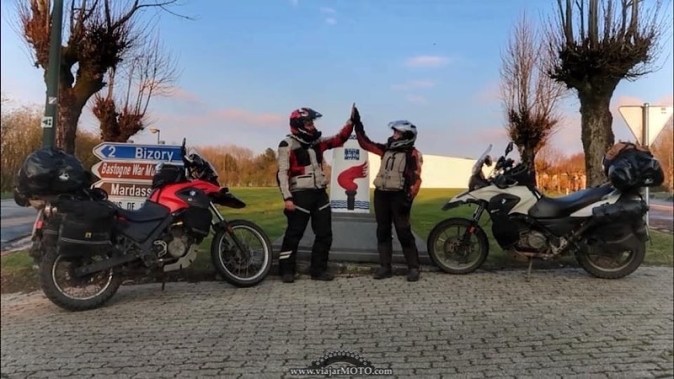
High five! Although it doesn’t look it, this was a bitter cold evening. We could find a nearby hotel for the night or ride two hours to our home in Germany.
We decided to ride home to Germany. We bundled up and made it home just before 10 PM. Operation Liberty Road complete!