


After a short break to avoid a few days of rain, we returned to the border of Netherland and Belgium to start the next portion of the TET – Belgium! Just a few days before we completed riding the Netherland TET and were looking forward to more offroad excitement.


The Trans Euro Trail continues heading southwest, starting at the Netherland border and winding through a beautiful countryside and rich history of the country of Belgium.
Day 1 – 5 Apr 2019

Belgium 🇧🇪 Kit Kat! I enjoy trying different foods in a country – especially candy so I was surprised that this Olé bar was the same thing as an American Kit Kat bar.
Klankenbos

We started our morning with a unique experience called the Klankenbos (Dutch for Sound Forest). It’s a park where you use your senses to explore the different exhibits – expecially the sense of hearing.

The visitors center has a map and a short explanation of what Klankenbos is all about. Check out the unique architecture of the building with a center section of transparent glass making the top section seem to float magically.


One exhibit features a walk-in bird cage with the recorder and natural sounds of canaries.

My favorite exhibit was these 24 birch trees spaced perfectly apart. They center podium provides instructions on how to make the trees come alive. Basically you call a number from the phone and then select via the keypad what kinds of motion pattern you want the tree to display. Each of the 24 trees has a motor that spins and shakes the tree to your selected pattern. It was a lot of fun to see, hear, and feel the different pattens.

A unique slide for the kids – or for us. The top one is quite long and fun! This is definitely a great place to bring children.

A large “OK” symbol has multiple meanings. I grew up playing the “circle game” as a kid so if your looking at this and the screen is below your waste I get to punch you!
This symbol has also, sadly, been associated with white supremecy. This symbol gained US media attention in Dec 2019 when some Midshipman and Cadets jokingly used this symbol during the yearly Army-Navy football game. An investigation showed they were just goofing around and playing the age old circle game.


A nearby petting park with art work painted on the walls.

The petting zoo had some chickens…

… and this funny guy who looks like he got rammed in the head by his buddies a bit too much!?!

The Klankenbos was a nice morning surprise and definitely a worthwhile stop – especially for kids.
We continued on our way exploring the backcountry of Belgium via the Trans Euro Trail (TET).
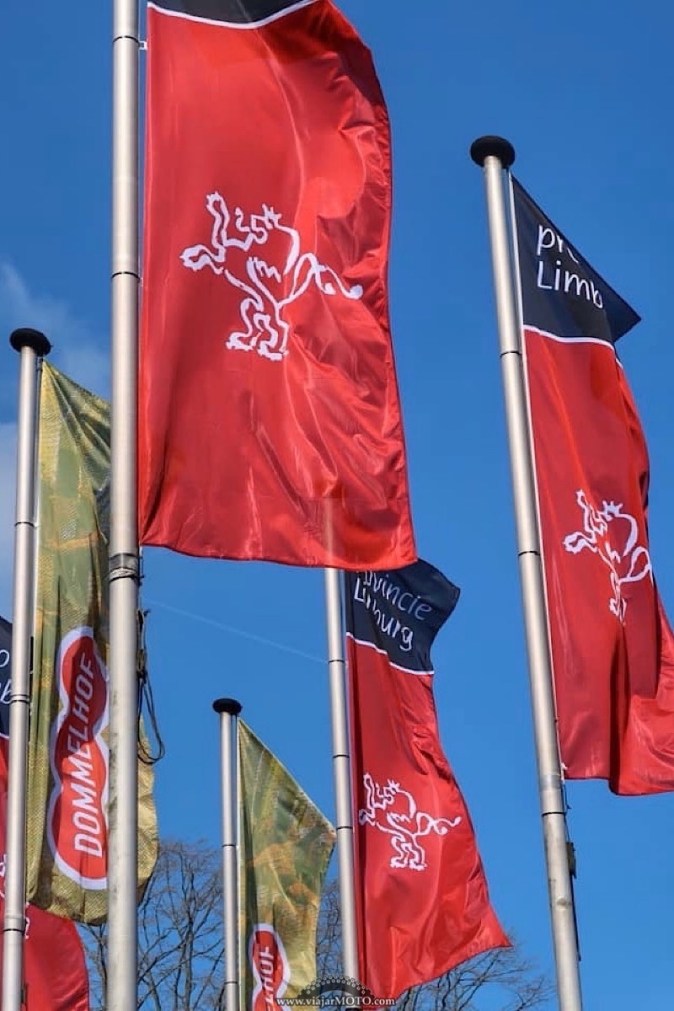
The lion is everywhere here; after all, it is the national symbol of Belgium.

Within an hour we ran across this mess! I know enough about mud that it’s best to avoid it!! There was just one little path on the right but there were two trees that make it difficult to get the handlebars and side-bags around. Together we got both mules though!!

I love how obvious the picture on this sign is!

We stopped in the town of Geel to grab a bite to eat and noticed a large inflatable yellow submarine had surfaced in the middle of the town center!

When in Belgium 🇧🇪 eat Belgium waffles!

St.-Amandskerk church stands above the town center. A large central church is common in most western European towns and cities.


And just like that (snapping of fingers) we are in French speaking Belgium 🇧🇪 – Bonjour!!
We ended up riding just before dark and still hadn’t found a campsite so we just pulled over in a quite forested spot and camped for the night. Until tomorrow…
Continue the adventure on Page 2
Day 2 – 6 Apr 2019

Ready for another day of riding the TET!
Stairway to Heaven
We started our morning with a short climb up the stairway to heaven! No we didn’t die?! 😳 It’s a roadside oddity in Belgium 😆…

Stairway to Heaven!

A really neat roadside oddity that was engineered and built really well.

Looking down at our mules from the top! The top of the stairs sway a little bit since there in no supports at the top.

A quote at the top reads in Dutch “I am not the way I was.”

A nice diversion to our morning ride!

This is farm country so we came across lots of horses and cows, but the Shetland ponies always got our attention.
Nieuwenhoven Castle

Nieuwenhoven Castle wasn’t a very interesting castle but the walking trails around it were enjoyable.

Enjoying a short walk through the forest…

Chantil made a friend with this fuzzy donkey by pulling tall green grass from the other side of the fence and feeding him.
TET Belgium

Back in the TET. Much of the roads were easy going but there were a few tricky muddy sections.

My kind of road. I think if people are respectful of each other than roads like this work well. We always slow down around others and even stop the engine for approaching horses.

Mud always seems to find us on these trails!

A nice day for riding through the backroads of Belgium.

What do you do when you have a bunch of wooden spools around your property? Make art out of them – off course!

While traveling through a small Belgium village we came across this mural.

But look at the other side! A lot going on over there!!

Fun and whimsical.

Our signs have switched to French “Slow Down – Nocturnal Migration of Amphibians”

A bunker reminds of a past where a united Europe did not exist.
Battle of Waterloo Memorial
These fields are remembered for a battle that took place on Sunday, 18 Jun 1815.

The most impressive part of the museum is this panorama contained within this historic building.

Walking through and sunken memorial gives you access to the panorama.


The horrors of warfare. Thousands of horses and men died on the battlefield that day.

The spiral staircase going to the panorama.

The sounds of 19th century warfare fill the air as you witness this incredible piece of history and artwork.

Wounded soldiers and horses litter the battle field.

War is hell! 65,000 casualties! All within a single day – 18 Jun 1815! This bloody Sunday battle marked the end of the Napoleonic Wars.

“This morning I went to visit the field of battle, which is a little beyond the village of Waterloo, on the plateau of Mont-Saint-Jean; but on arrival there the sight was too horrible to behold. I felt sick in the stomach and was obliged to return. The multitude of carcasses, the heaps of wounded men with mangled limbs unable to move, and perishing from not having their wounds dressed or from hunger, as the Anglo-allies were, of course, obliged to take their surgeons and waggons with them, formed a spectacle I shall never forget. The wounded, both of the Anglo-allies and the French, remain in an equally deplorable state.”
—Major W. E. Frye


The climb up the 225 steps to the Butte du Lion “Lion’s Hillock/Knoll”

We enjoyed fresh strawberries and the surrounding beautiful views.

A map shows where the troops started and the battle took place. It comforting to know that these fields now give life with abundances of food.

The Panorama building looking down from the steps.

The lion looking up from the very bottom. We decided to wait until after the park closed to get a better view of the lion…

…with the drone. Jean-Louis Van Geel (1787–1852) sculpted the model lion that weighs 28 tonnes (31 tons), has a height of 4.45 m (14.6 ft) and a length of 4.5 m (14.8 ft). Its right front paw is upon a sphere, signifying global victory.
After learning a bit about the Battle of Waterloo we found a campsite nearby and got some sleep. Tomorrow we may deviate from the TET in order to visit some WWI sites and other places of interest…
Visit Page 3 for Georges Remi Museum, Street Art in Louvain-la-Neuve, and TET mud!
Day 3 – 7 Apr 2019
Georges Remi Library and Museum
We started our morning by visiting a museum dedicated to Belgian cartoonist Georges Remi (1907–83), who wrote under the pen name Hergé. He created the Adventures of Tintin series of comics.

I’ve enjoyed reading The Adventures of Tintin ever since I heard about this comic book series as a young adult. The Hergé Museum celebrates the life of the artist who created this series – Georges Remi.
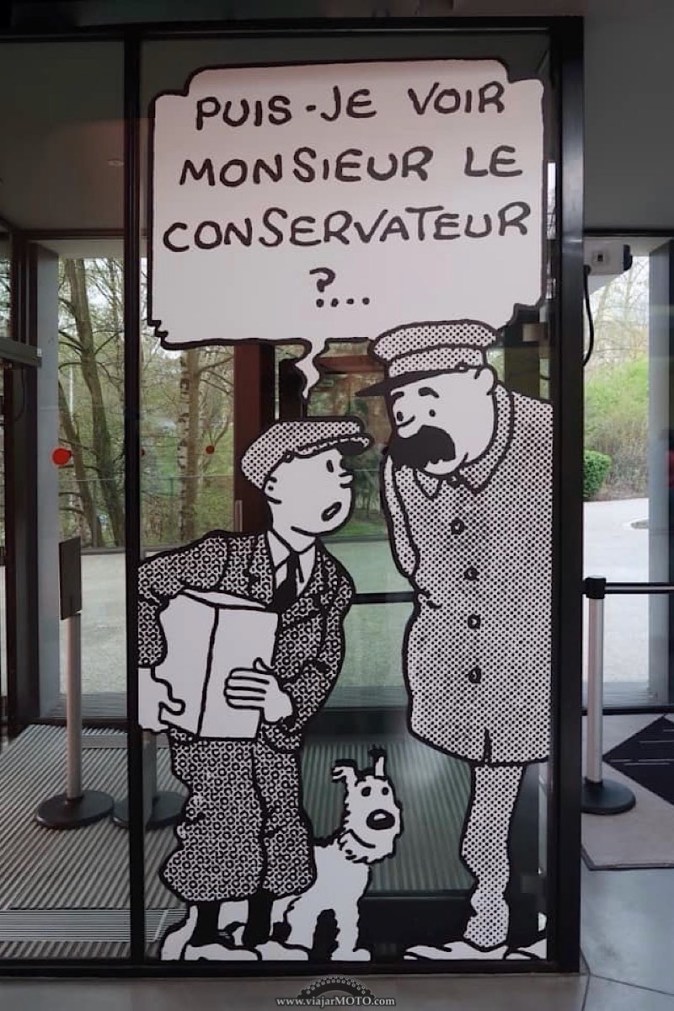

The building is very modern and creates a nice flow from room to room as you learn about the life of Georges Remi.
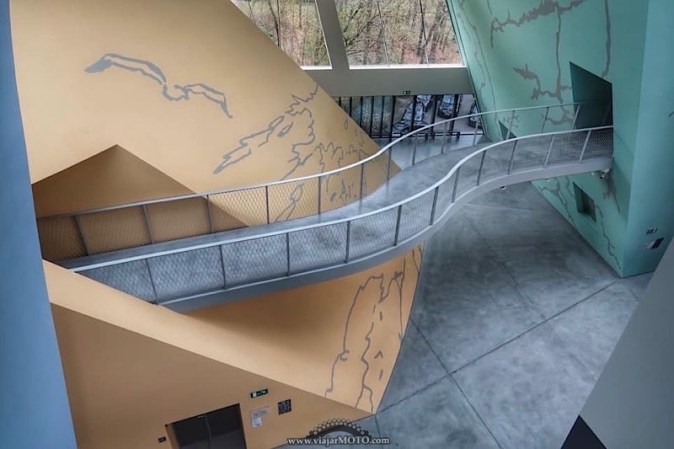
Walkways connects each of the individual galleries.

Georges Remi as a young man who though about being a painter but felt illustrations and cartoons could influence more people.

His Illustrations, like this one titled ‘Bambi’, are works of art in their own right.

I especially liked the section with Hergé’s sketches and storyboards.

He spent an extensive amount of his time storyboarding ideas and the flow of the storyline.

Remi was also an accomplished illustrator and poster designer.


One of his favorite characters he created was Tintin’s sidekick dog…

…a white Wire Fox Terrier named Snowy!

Snowy had a personality that was just as though-out as any of the other Hergé characters.


Thomson (left) and Thompson (right), the two bumbling detectives. There is a difference between these twins – can you spot it?

Hergé’s drawings have a unique style and artistic quality.


Hergé created over 200 different characters in his books…

…Here are the names of just some of them!

I enjoyed reading Tintin because of the far away lands and people he would meet along the way. Perhaps this is part of the wanderlust I have to see and experience far away lands.

Hergé often used models to help him draw the comics. Here is the Shark Submarine used in the book Red Rackham’s Treasure.

More of the architecture connecting the galleries.

Hergé also purchased art to inspire future ideas.

This was an inspiration for some of the American Indian characters.


I thoroughly enjoyed the couple hours we spent getting to know Georges Remi and the inspirational comics he created over his lifetime.
Street Art in Louvain-la-Neuve, Belgium
The city of Louvain-la-Neuve surprised me with the wide variety of street art we saw in our short walk to find the Hergé Museum and some Belgium waffles.

An ugly tagged door in a beat-up street caught my eye…

…because of this beautiful stencil art of two girls dancing.

A unique way to lay bricks. I wonder if one could practice wall climbing on these?

A boring stairwell brought to life through vibrant colors and strong line work.


For some reason I like this lion. Perhaps it’s the stylized use of African patterns?

C’est la Vie by Claude Rahir

I like the smile on this cow!

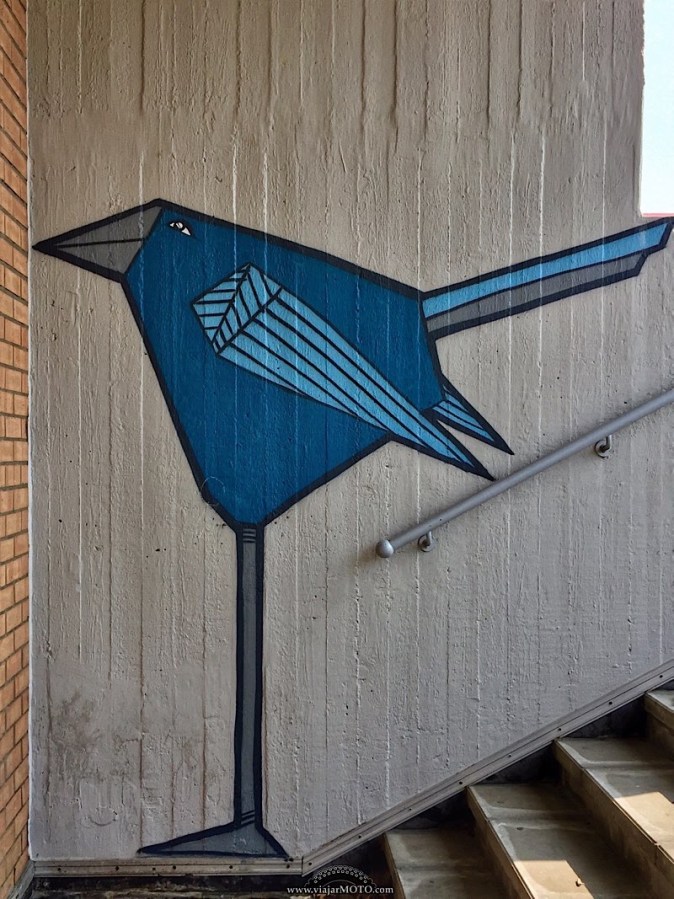

This mural titled “U’est-ce qu’un intellectuel?” by Roger Somville seemed to compliment the colors of the red and blue “no parking sign”.

“Live great, enjoy the little things.”

As we were leaving the city, we stumped across these three walls near a parking lot.


A smiling panda 🐼 bear looks over the parking area below.


Trans Euro Trail – Belgium
The rest of the day was getting through some challenging parts of the TET since the recent rainfall created a lot of mud on the trail.

My turn to drop my mule! Rider and mule OK. Mud definitely makes riding a lot more challenging.

Mostly cloudy today with a few rays breaking through the clouds for a few minutes.


Our mules will definitely need a bath after this trip.
This may be our last day on the TET since the mud is really slowing us down and more rain is expected tonight. Pounding pavement is not a fun but we still need to explore France before we run out of vacation time.
We continue the adventure on Page 4…
Day 4 – 8 Apr 2019
Remembering World War I
Today was an opportunity to learn and experience “The Great War” of 1914-1918. We started by visiting Hill 62 Sanctuary Wood followed by a nearby cemetery.
Hill 62 Sanctuary Wood

Hill 62 is one of the last areas to have preserved the trenches of WWI and it provides an interesting view into the harshness of war and trench warfare.

Imagine living in these muddy trenches for months at a time?

With the constant fear of an enemy mortar whistling from the sky, exploding nearby, and sending hot shrapnel ripping though your body.


The poppy flower is the symbol of WWI remembrance.

The museum featured stacks of old shells in all various sizes.

The museum shelves were filled with WWI memorabilia from both the Allied and Central Powers.


A poster for helping identify friendly vs enemy aircraft.

A recruiting poster to join the cavalry.

Manfred von Richthofen’s, also known as The Red Baron, famous red Fokker Triplane. He is buried near Frankfurt, Germany.

Nearby was just one of hundreds of cemeteries within this area.

Here rests the bodies of men who never returned home.

So many where unnamed.


A Canadian soldier without a name.


Well wishers leave notes and their promise to never forget.

The history lesson continued as we rode our way to the city of Ypres, Belgium.
Saint Martin’s Cathedral, Ypres

This Romanesque church was completed in 1370. The church was heavily damaged during the First World War and from 1922–1930 the ruin was cleared and the church was entirely rebuilt following the original plans.

An impressive architectural building!

With beautiful stained glass windows throughout.

The church had a variety of artwork and sculptures.


A symbol of the city that stretches 102 meters high.

Just outside the church is the Ieper War Victims Monument…

…which is dedicated to remembering the 176 civilian and military victims who died during WWI and WWII from Ieper and Ypres.
In Flanders Fields Museum

The museum was named after the famous poem by Canadian John McCrae.

The displays were educational and well designed. There are hideaway sections, like this one, where the horrors of warfare are discussed and shown with photographs taken during WWI.

The weapons of warfare. The horse was a key player in the success of moving heavy machinery throughout the battlefield. Watch the movie War Horse to get a better understanding of how horses were used during WWI.

Artifacts from a sad part of our human history.

21 million people were wounded during the four years of the First World War. Many suffered the rest of their lives.

Trench warfare was hell, with not much to look forward to other than the same meals and maybe an occasional cigarette.

We walked the stone stairs to the top of the tower. Halfway up we discovered that up until 1817 there used to be a ceremony in May where the town fool would throw living cats from the tower to chase away evil spirits.

Sadly, from this height, there was no way the cats would have lived.

Fortunately, the ceremony is now changed! Every three years on the second Sunday of May there is a huge celebration and parade for our furry feline friends. A cat is still thrown from the tower; however this time it’s a velvet cat. If you catch it, you can make a wish.

The final display asks the question “Is war worth it?” This is a complicated question…

…Europe is much better off today than it was in the 1910s and 1940s…

…but it took numerous wars and unnecessary bloodshed to get to this point in history.

Perhaps it’s best if we just remember history and promise to ensure that this dark past is not repeated.
Menin Gate
The Menin Gate Memorial to the Missing is a war memorial in Ypres, Belgium, dedicated to the British and Commonwealth soldiers who were killed in the Ypres Salient of World War I.

Two stone lions stand guard at the Menin Gate. These were gifted from the Australian Government to the city of Ypres.

Red Poppy wreaths are dedicated to those who died while serving their country.

So many names…

…The memorial lists 54,896 names. All of them have unknown graves.
After visiting the sites of Ypres, Belgium we made our way across the border to France and then found a campsite near the beaches of Normandy. Tomorrow we will begin our tour of the La voie de la Liberté (Liberty Road).